
When Vancouver hosted the Winter Olympics three years ago, the thousands of travelers who flooded the city from around the world for the games also boosted duty-free sales at the local airport to a record-breaking level in one day.
“Remember this day, because you won’t see it again,” Freda, Cheung, the chief executive officer for Canada of World Duty Free Group, recalled telling a colleague in the airport at the time.
Yet just three years later, Cheung and her team proved those words wrong when a group of 600 Chinese travelers passed through the airport in January and smashed that Olympics sales record, which had involved sales to thousands of consumers. It was no accident, Cheung said here Wednesday. Rather, her company made deliberate, calculated steps to court Chinese consumers, planning well in advance with Chinese-language signs, Chinese-speaking staff and products and promotions to suit their tastes.
“Understanding why Chinese travelers are at our airports is key to selling to them,” Cheung told the Tax Free World Association’s “China’s Century” conference, which is meeting in the Chinese capital this week.
RELATED STORY: India Cuts Excise Duty >>
Cheung joined a catalogue of industry experts and analysts on Tuesday to discuss insights and strategies related to the duty-free world’s most important growing group of customers: Chinese travelers and shoppers who buy duty-free products ranging from cosmetics and fashion accessories to cigarettes and liquor.
They discussed airport strategies inside and outside of China, economics and potential challenges, but the general agreement appeared to be that China’s fast-growing travel market combined with the heavy and growing demand for high-end goods at a decent price presents massive opportunities for the industry. Most agreed that any new anticorruption effort in China will not negatively impact growth in sales.
“The fact that we are gathered here to talk about one passenger is proof alone of the power of the Chinese traveler,” said Emmanuel de Place, ceo of LS travel retail ASPAC.
China’s tax-free shopping boom is unique and intimately tied in with both the country’s dramatic surge in wealth in recent years and government fiscal policies. Duty-free sales began here some 30 years ago, but in the past decade, they have increased exponentially, both within China and internationally. Steep taxes on the domestic retail sales of luxury goods mean duty-free products are significantly less expensive, so much so that international shopping trips to destinations like Paris and Tokyo have become common.
Hong Kong has built a massive tax-free shopping industry that caters to Chinese tourists, including weekend tourists who flock to designated duty-free malls designed with them in mind. Within China, the government has recently designated Shanghai as the country’s second duty-free shopping zone, joining tropical Hainan Island as a location where certain retailers will be able to sell middle and high-end consumer goods without charging the hefty taxes.
A regulation on the new Shanghai duty-free zone in January said the government will “explore tax rebates on departure in coordination with national-level administrations and select locations to set up duty-free shops,” according to a local press report.
Duty-free retail is such an important component of China’s high-end shopping scene that it’s even driving real-estate development in Hainan.
On the island, work has begun on a 7.7-square-mile residential, golf, spa and shopping development that will cater to tax-free shoppers, said Philippe Schaus, ceo of the duty-free giant DFS, which is a partner in the project.
“We believe this property creates all the elements to become an attraction and destination on itself,” said Schaus.
By the numbers, Chinese consumers made 50 million overseas trips last year and that statistic is rising fast. According to TFWA and the experts, Chinese duty-free shoppers, projected to have spent $80 million on those overseas trips, differ from other groups in several ways. They want personal interaction with staff, are eager for sales and discounts and buy more at holiday time, just before the Chinese New Year in late winter.
Retailers need to take these factors into account and plan and train staff accordingly, speakers suggested. Personal shoppers can be helpful, as is having staff who can speak Mandarin.
Beyond the international duty-free scene, industry executives spoke of tremendous growth opportunities within China’s borders as regional airports open up to international connections. At present, China is not a huge transfer hub and many international flights go through large airports. That is likely to change in the near future, opening up tremendous potential markets outside of Beijing and other large cities.
Sunil Tuli, managing director for duty free of the King Power Group in Hong Kong, said that while rising labor costs and other issues present challenges moving forward, the strength of the Chinese market will continue to grow and outweigh potential pitfalls.
“We face the newest and most exciting travel retail audience in the world,” said Tuli.
===============================
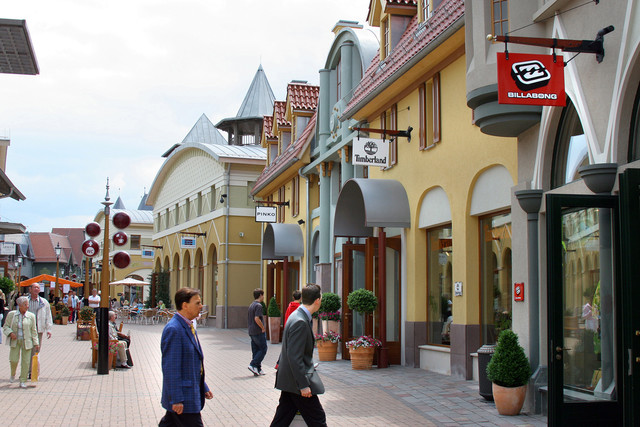
Australian tourists Erica Kim and Michael Cai walk out of Bicester Village outlet mall near London loaded down with purchases including Jimmy Choo boots, Bally shoes and a dress. They figure they’ve saved about 1,000 pounds ($1,500) compared with shopping at home.
Outlet centers across Europe are attracting visitors from as far away as China and Brazil with discounts of 60 percent or more on year-old apparel by luxury labels like Gucci and Prada, as well as on jewelry and other goods. That’s lifting revenue at companies backed by investors such as Carlyle Group LP (CG), Hammerson Plc (HMSO) and Henderson Global Investors, and fueling the industry’s expansion even as conventional retailers struggle.
“When times are tough, people still like to shop, they still like brands,” said Robert Hodges, head of European asset management at Carlyle, which bought London-based outlet operator Freeport Group in 2007. “We’ve seen consistently better performances in terms of footfall and overall turnover at the centers and, because we’ve got percentage rents, that filters down to us as rental payments.”
Revenue at European outlet malls climbed to 10.8 billion euros last year, a 60 percent gain from 2007, according to estimates by industry adviser FSP Ltd. Owners and operators benefit more from rising sales than malls with full-price retailers because they keep as much as 18 percent of the price of each item sold by the brands at their outlets. There are 201 outlet malls in Europe, excluding Russia and Turkey, FSP said in January.
Increased Spending
Sales at the nine luxury-brand outlets built and operated by London-based Value Retail Plc, including Bicester Village, almost tripled to 1.7 billion euros in the five years through 2012. Spending per visit rose 9.4 percent in 2012. The closely held company, Europe’s third biggest outlet-mall owner by floor space, is forecasting a 20 percent gain in sales this year, according to Chairman Scott Malkin.
Rising revenue is increasing the value of the company’s assets at a time when conventional stores and shopping malls in the U.K. are depreciating. Hammerson, the London-based real estate investment trust that owns 22 percent of Value Retail, said last week that the value of its stake increased by about 18 percent last year.
Shopping-mall sales in mainland Europe fell 34 percent to 6.1 billion euros in the first half of 2012, according to data compiled by Real Capital Analytics Inc. U.K. commercial property values fell by 3.1 percent last year and retail assets declined 3.2 percent, according to Investment Property Databank.
Growth Prospects
Henderson Global Investors’ European outlet fund has generated annual returns of about 12 percent for investors since it started in 2004. The fund, which owns eight malls with McArthurGlen Group in Europe outside of the U.K., is due to mature next year. Henderson is in talks with clients to renew the investment pool rather than sell the properties, according to Andrew Rich, who manages the fund.
“There’s a lot more growth to come out of those assets,” he said.
The fund in September opened a 120 million-euro center in the German town of Neumuenster, about 57 kilometers (35 miles) north of Hamburg, in a joint venture with London-based McArthurGlen, Europe’s largest outlet-mall operator. The fund is considering expanding the mall and may increase the number of stores at a center near Berlin, Rich said.
Changing Hands
Henderson’s fund sold outlet malls in 2010 and 2011 at Troyes and Roubaix in France to Resolution Property Plc. Closely held Resolution, based in London, also bought Rosada Factory Outlet, 50 kilometers south of Rotterdam, in December from CBRE Global Investors. The three properties have risen in value by about 25 percent to 200 million euros since they were purchased, Resolution director Peter Todd said.
“They have fantastic potential for income growth,” he said in an interview. Resolution may spend an additional 200 million euros or more on outlet malls, he said.
Outlet malls in Europe differ from those in the U.S. because they tend to have a greater proportion of shops selling high-end luxury products, Iestyn Roberts, chief executive officer of Freeport, said in an interview. U.S. centers are more likely to sell apparel made specifically for discount stores.
Luxury goods account for about 40 percent of sales in Europe’s outlet malls even though they occupy only 22 percent of the space, FSP estimates.
The U.S. outlet mall market is dominated by Indianapolis- based Simon Property Group Inc., the biggest shopping-center owner, and Tanger Factory Outlet Centers Inc. McArthurGlen Group has 15 percent of the U.K. market, while Madrid-based Neinver controls 9 percent. Both companies are closely held.
For foreign shoppers coming to Europe, designer brands tend to be a bargain even without the discounts offered at outlet centers. The cost of 20 luxury items in China, including bags and watches, was 72 percent higher than in France, according to a 2011 survey by China’s Ministry of Commerce.
Demand outside of Europe for brands owned by companies like Burberry Group Plc (BRBY) and Prada SpA means that foreign shoppers spend twice as much per visit than Europeans, according to data compiled by FSP. Scarcity and factors like import duty boost prices in countries like China and Brazil, Freeport’s Roberts said. Tourists from outside the European Union can also claim back the sales tax paid on their purchases.
Parking was hard to find on a Tuesday afternoon in January at Bicester Village, about 50 minutes by train from central London.
Australians and Chinese were among those looking at Gucci handbags reduced by more than 75 percent from their original price of 500 pounds. Women’s black ankle boots by Armani were 70 percent off and navy chalk-stripe suits by London’s Savile Row tailor Gieves & Hawkes were marked down to 495 pounds from 2,250 pounds.
“Things are so much cheaper here,” said Kim, the shopper from Australia. “You can get luxury brands for reasonable prices.”
Hayden Dong, a mechanical engineering student from Beijing, said he bought a Gucci purse at the center after comparing prices with those in China. Spending by Chinese visitors to the U.K. rose 31 percent last year, according to tourism services provider Global Blue.
Meyer Bergman, a London-based fund seeking to buy assets worth as much as 600 million euros, has hesitated to invest in outlet malls, according to Zsolt Kohalmi, its chief investment officer. Bergman has yet to purchase any because of questions about liquidity in the market and the types of investors that would acquire the assets afterward, he said.
Earnings at Freeport have tripled since it was acquired by Washington-based Carlyle, the world’s second-largest private- equity firm, for 155 million pounds in 2007, Roberts, the CEO, said in an interview. He declined to say how profitable the company is.
Freeport plans to add malls at Lyons in France, Duisburg in Germany and La Spezia in Italy, and may take over the management of underperforming outlets from other operators, he said.
Sales at outlet malls are surging even in some of Europe’s most troubled economies such as Portugal and Ireland. Tourists, especially from Brazil, now account for as much as 25 percent of sales in the summer at Freeport’s center near Lisbon, a fivefold increase in three years, Roberts said.
That spending helped increase the center’s value by 25 percent in the three years through 2012. Values for the best shopping malls in Portugal fell about 15 percent in the same period before rent increases or decreases are taken into account, according to broker Jones Lang LaSalle Inc. (JLL)
“It’s also pushed us upmarket,” Roberts said of the Lisbon outlet. “Every time we put in a high-end brand we’ve increased our appeal to those tourists.”
Value Retail plans to expand its mall in Ireland’s County Kildare by about 60 percent, according to a filing to the country’s planning appeals board. Sales there have grown an average of about 17 percent a year in the six years through 2012, according to data compiled by the company. That compares with a decline of almost 25 percent in the wider market.
“They can shift the offer around to suit what the consumer is looking for at the moment,” said John Moran, chief executive officer of Jones Lang LaSalle’s Irish unit and an adviser to Value Retail’s Kildare outlet. “It’s also quite popular with retailers who are testing whether they want to open in Ireland.”
Malkin aims to spend as much as 150 million euros on growth in Europe in the next three years, he said in an interview. The outlet operator will extend its mall near Barcelona by a third this year, Hammerson said.
Other real estate investors are planning to enter the market. Quintain Estates and Development Plc is building an outlet center with 85 shops near Wembley stadium in London. On the other side of the city, a unit of Anschutz Entertainment Group Inc., part owner of the National Basketball Association’s Los Angeles Lakers, may develop a 13,500 square-meter (145,300 square-foot) outlet mall near the Canary Wharf financial district, according to a filing to the local government.
Some management costs at outlet malls are higher than traditional shopping centers because more people are needed to run them than typical malls.
Operators tend to replace underperforming brands more frequently and have to fit out stores for new tenants and offer them rent-free periods as part of the leases, according to Todd. The operators also have to spend part of their fees promoting their malls abroad.
“Nobody walks into our centers naked,” Roberts said. “You have to persuade them this money is really worth spending.”
To contact the reporter on this story: Neil Callanan in London at ncallanan@bloomberg.net
To contact the editor responsible for this story: Andrew Blackman at ablackman@bloomberg.net
http://www.businessweek.com/news/2013-03-06/investors-thrilled-as-shoppers-fill-europe-s-outlet-malls#p1
联系:nofashion.cn@gmail.com
关注无时尚中文网微信号:nofashioncn

 霞飞诺二季度加速反弹 中期扭亏为盈意大利眼睛制造商Safilo Group SpA 霞飞诺集团中期业绩显著改善,管理层在财报中重申2020年恢复收入增长及可持续财政状况的展望,刺激股价在周一全球股市崩盘的背景下飙升最多12.7%至0.994欧元。08月03日 04:08
 艾莱依巴黎时装周发布法国当地时间周二晚,来自中国的时尚服装品牌ERAL 艾莱依首次亮相巴黎时装周,以“醒”为主题发布2018秋冬系列。03月07日 19:26
 梅西百货股价大涨 据悉接获财团58亿美元私有化与同行Target Corp. (NYSE:TGT) 塔吉特集团一样,Macy's Inc. (NYSE:M)梅西百货三季度尽管销售下滑,但盈利表现好于预期,且利润率逐步改善。11月16日 21:21
 马云套现 电商放缓 阿里巴巴股价狂泻淘天集团收入增长放缓,尽管受益降本增效盈利超预期,但盒马IPO搁置、不再寻求拆分云业务,加上创办人马云拟套现1,000万股,Alibaba Group Holding Ltd. (NYSE:BABA)(9988.HK)阿里巴巴在管理层重组后首个季度表现令人失望,公司股价周四在美股暴跌逾9%。11月16日 21:20
 轻奢巨头Capri卖身后越发摆烂 Michael Kors、Versace范思哲销售全线扑街在8月宣布出售予竞争对手Tapestry Inc.(NYSE:TPR)泰佩思琦后,美国奢侈品集团Capri Holdings Ltd.(NYSE:CPRI)越发摆烂,公司二季度表现糟糕。11月12日 19:44
 进博会观察:科技加持 雅诗兰黛率美容业可持续发展 11月08日 17:56
 始终扎根香港获回报 六福中期盈利暴涨在公布强劲的中期业绩后,香港珠宝集团六福集团(0590.HK)股价周四飙升逾7%,与同行周大福珠宝集团有限公司(1929.HK)业绩后股价狂跌形成鲜明对比。11月30日 14:05
 内地销售低迷 周大福股价暴跌尽管中期收入和纯利双双反弹,但极度依赖中国内地市场的全球最大珠宝商周大福珠宝集团有限公司(1929.HK)股价绩后狂泻逾一成,投资者担忧内地市场的低迷表现将拖累公司未来表现。11月24日 16:01Tory Burch传上市Tory Burch LLC据传正聘请Morgan Stanley摩根士丹利探索战略性选项。11月02日 13:22Morgan Stanley
 业绩低迷 上海家化上半年盈利下滑公司存货为 10.23 亿元,存货周转天数同比上升 13 天,主要系国内法规改稿 库存备货增加;期末应收账款为 13.19 亿元,应收账款周转天数同比上升 2 天。报告期内,公司 实现经营性现金流 6,563 万元,同比下降 84.91%,现金流下降的主要原因为向下属子公司 Financial Wisdom Global Limited 的管理层支付股权激励行权现金 2,807 万英镑,另外支付品 牌、电商市场投放费用和研发费用同比增加。08月31日 13:26
 资生堂重申中国不再大搞促销受益中国市场的反弹以及日本市场的稳定表现,日本美容巨头Shiseido Co. Ltd.(4911.T)资生堂集团二季度加速增长,期内可比销售录得10.3%的增幅,较疫情前同期亦有2%的增幅。08月09日 14:40
 梅西百货股价大涨 据悉接获财团58亿美元私有化与同行Target Corp. (NYSE:TGT) 塔吉特集团一样,Macy's Inc. (NYSE:M)梅西百货三季度尽管销售下滑,但盈利表现好于预期,且利润率逐步改善。11月16日 21:21